Purpose#
Calculate the position of a permutation in all permutations.
Derivation#
Follow the process in the PPT.
Example: For the set {1,2,3}, what is the position of {3,2,1} in all permutations?
Before {3,2,1}, there are three cases:
-
The first item < 3:
It must be before
{3,2,1}, at this point, the first item has two choices, the last two items can be any, so there are a total ofpossibilities.
-
The first item = 3:
If the second item < 2, the result is less than
{3,2,1}. -
The first two items are equal:
There is no permutation smaller than
{3,2,1}.
In total, there are 2*2!+1*1!+0=5 possibilities.
Calculation Formula#
where pi represents the number of elements smaller than ai in the unselected elements.
Reverse Calculation#
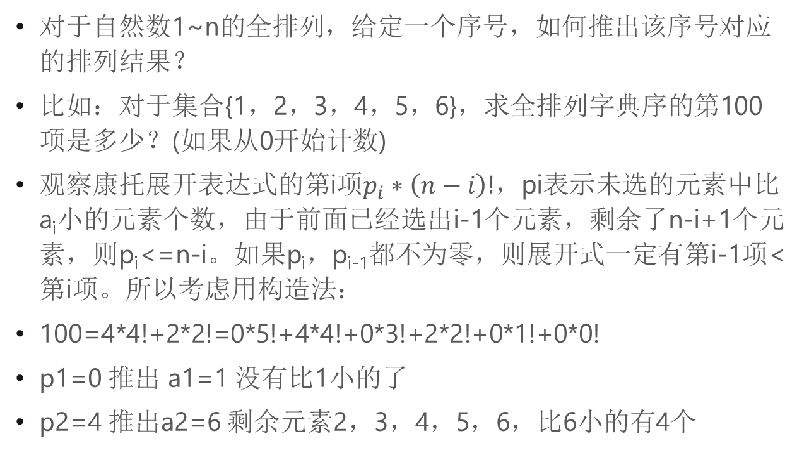
Given a position, calculate the permutation result.
Example: For the set {1,2,3,4,5,6}, find the 100th permutation (counting from 0).
Um... let's just refer to the PPT.